For banks, End-of-Day (EOD) batch processing is the heartbeat of operational continuity and regulatory compliance.
Each night, millions of transactions must be:
Reconciled across payment, core banking, and treasury systems
Settled across internal and interbank ledgers
Posted to customer accounts and general ledgers
Rolled into daily compliance and MIS reporting
This entire cycle must complete before Beginning-of-Day (BOD) to allow a clean operational start.
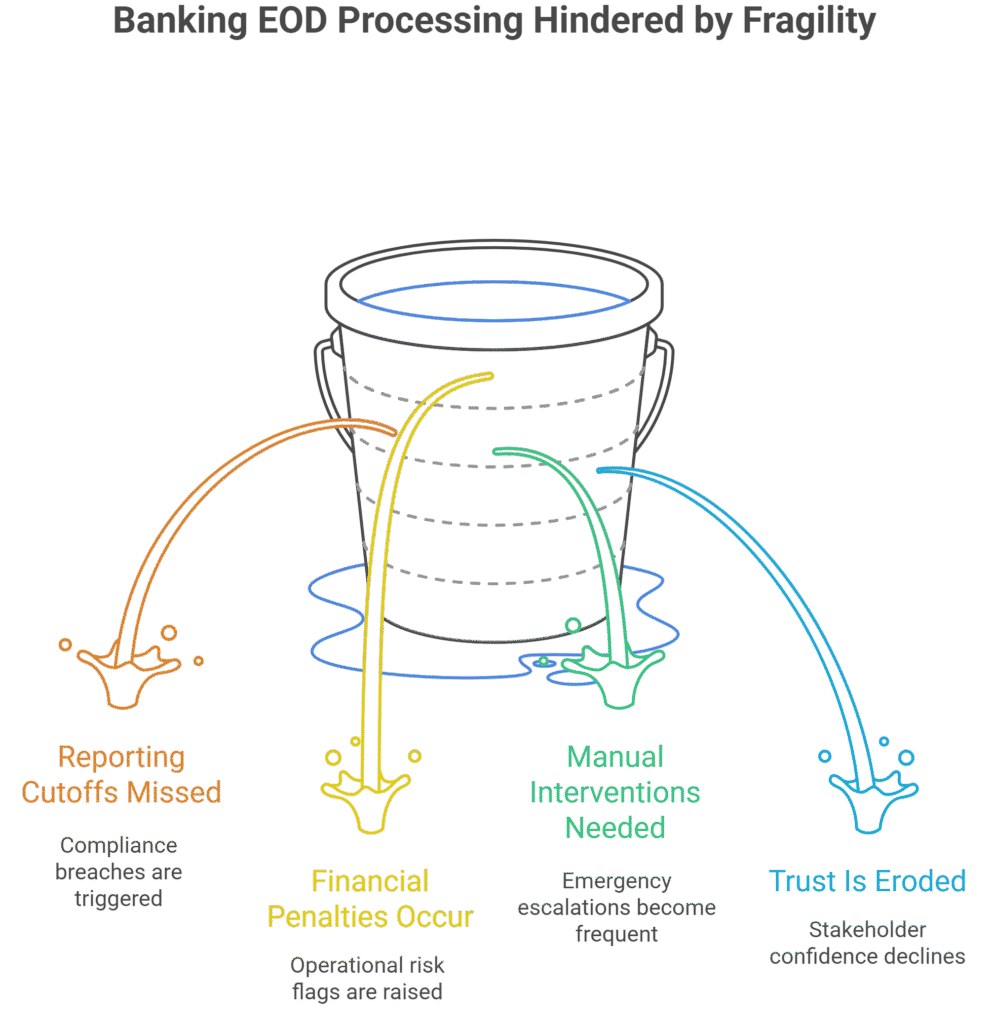
Even minor delays can trigger:
Missed regulatory reporting cutoffs and compliance breaches
Financial penalties and operational risk flags
Costly manual interventions and emergency escalations
Erosion of trust with regulators, auditors, and customers
While banks invest heavily in EOD functional logic, infrastructure fragility is often the hidden cause of failure — an area most traditional monitoring overlooks.
In a leading retail bank, EOD batch cycles began consistently overrunning the available overnight window. Business logic was sound, yet:
Application servers intermittently went offline during batch execution
Middleware nodes became saturated under concurrent job loads
Database storage showed latency spikes during ledger reconciliation
Alert noise from multiple tools made it hard to isolate the root cause
These infrastructure slowdowns consumed critical time buffers, pushing batch completion dangerously close to BOD, risking compliance violations and downstream settlement failures.
The bank needed a resilient, self-healing infrastructure layer to protect the EOD window.
QPH deployed its flagship IntelliPulse HUB (IPH) to fortify the bank’s infrastructure foundation for EOD cycles.
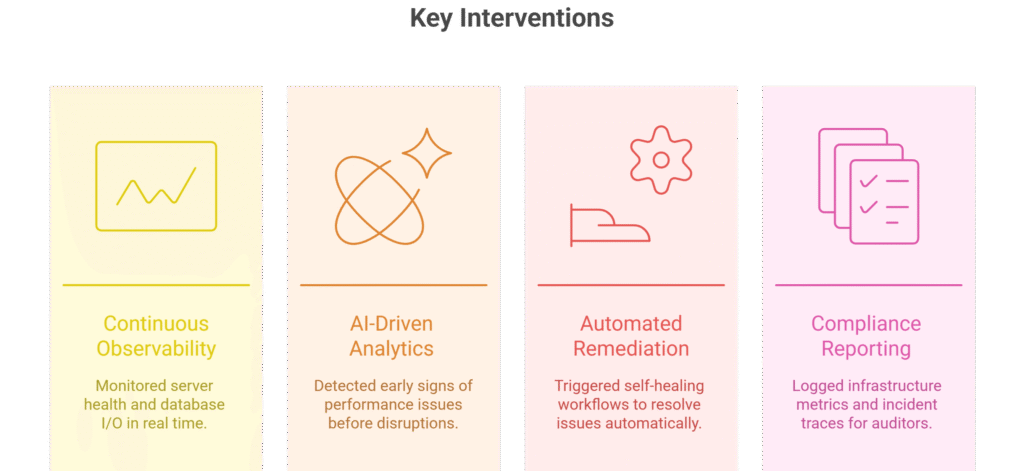
Key interventions included:
AI-Driven Performance Analytics
Detected early signs of CPU contention, memory leaks, and storage lag before they disrupted batch schedules.
Automated Remediation Playbooks
Triggered self-healing workflows to restart failed nodes, clear resource locks, and rebalance loads without manual intervention.
Compliance-Ready Reporting
Logged full infrastructure availability metrics and incident traces to provide auditors verifiable assurance of EOD stability.
Within weeks, the bank shifted from nightly firefighting to predictable, resilient EOD completion:
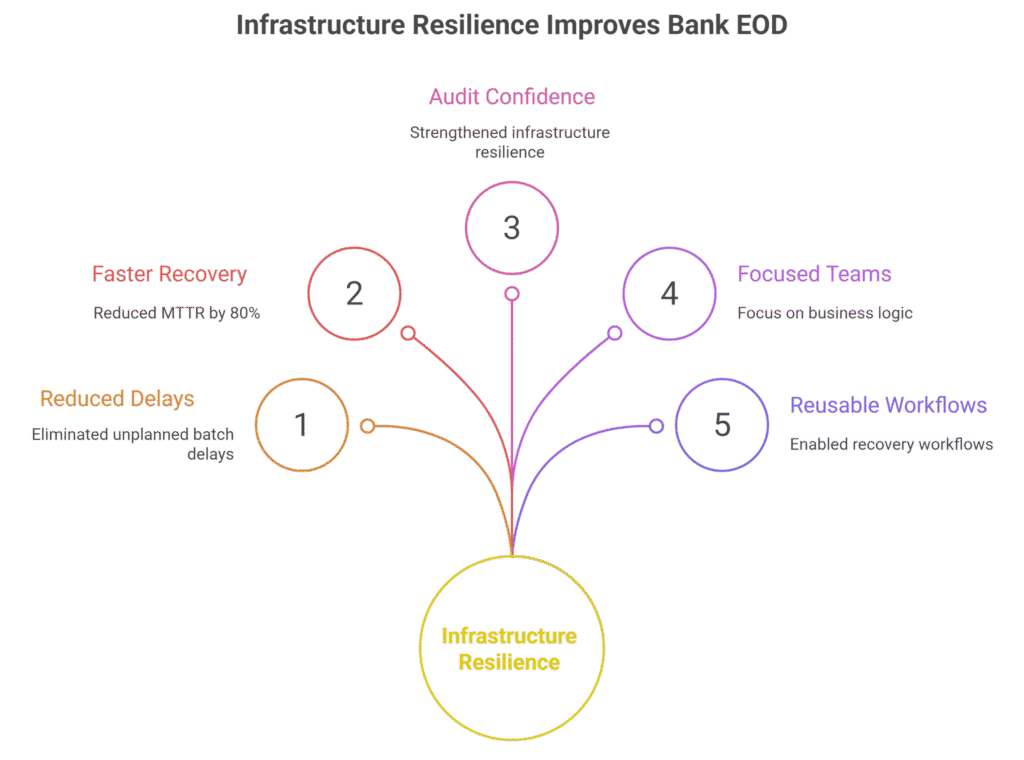
Eliminated unplanned infrastructure-related batch delays
Reduced mean time to recover (MTTR) for system incidents by 80%
Strengthened audit confidence in infrastructure resilience
Freed operations teams to focus on business logic, not platform stability
Enabled reusable recovery workflows for future EOD cycles
This transformation gave the bank confidence that EOD delays will never stem from infrastructure failures, even during high-volume month-end or quarter-end loads.